
Dear readers, to begins with, I started this blog to dive into the world of physical quantities and make sense of how we measure everything around us.
First and foremost, physical quantities are the backbone of science, they let us turn observations into numbers we actually work with.
If you want to download book exercise questions and answers pdf of Sindh text Book for 9th Class.
INTRODUCTION TO PHYSICS AND PHYSICAL QUANTITIES:
Physics is the branch of science that deals with the study of matter, energy and the relationship between them. The word physics has been derived from the Greek word “physis” meaning nature.The study of physics is based on measurements of physical quantities.
Experiments and theories are the two pillars of physics.
BRANCHES OF PHYSICS:
Physics is a vast subject. For the convenience of study it is divided into the following main branches:
Mechanics: Mechanics deals with the motion of objects and the forces acting on them. It is further divided into statics, kinematics, and dynamics. Example: Motion of car, falling of apple from tree.
Heat and Thermodynamics: It deals with the nature of heat, modes of transfer of heat, and conversion of heat into other forms of energy. Example: Working of refrigerator, steam engine.
Sound: Sound deals with the production, propagation, properties and applications of sound waves. Example: Echo, sonar.
Light or Optics: It deals with the nature, propagation, properties and applications of light. Example: Working of camera, microscope, telescope.
Electricity and Magnetism: It deals with the charges at rest and in motion, their effects and the relationship between electricity and magnetism. Example: Working of motor, generator, fan.
Atomic Physics: It deals with the structure and properties of individual atoms. Example: X-rays, laser.
Nuclear Physics: It deals with the structure, properties and reactions of atomic nuclei. Example: Nuclear reactor, radioactivity.
Plasma Physics: It deals with the study of the fourth state of matter called plasma. Example: Sun, stars, fluorescent tube.
Geo Physics: It deals with the study of the internal structure of the Earth. Example: Earthquakes, seismographs.

PHYSICAL QUANTITIES:
Those quantities which can be measured are called physical quantities. Example: Length, mass, time, temperature, speed, force, etc.
Non-physical quantities: Love, hate, fear. These cannot be measured.
BASE AND DERIVED QUANTITIES :
Base Quantities: The quantities on the basis of which other quantities are expressed. There are seven base quantities.
Derived Quantities: The quantities which are expressed in terms of base quantities through multiplication or division. Example: Speed = distance/time, Area = length × width
INTERNATIONAL SYSTEM OF UNITS (SI) FOR PHYSICAL QUANTITIES:
In 1960, the 11th General Conference on Weights and Measures adopted a world-wide system of measurements called SI units.
Seven Base Quantities and Their SI Units
Base Quantity SI Unit (Symbol)
- Length metre (m)
- Mass kilogram (kg)
- Time second (s)
- Electric current ampere (A)
- Thermodynamic temperature kelvin (K)
- Intensity of light candela (cd)
- Amount of substance mole (mol)
Some Derived Quantities
Derived Quantity Expression SI Unit (Symbol)
- Area = length × width square metre (m^2)
- Volume = length × width × height cubic metre (m^3)
- Speed = distance/time metre per second(m/s)
- Acceleration = speed/time metre per second squared (m/s^2)
- Density = mass/volume kilogram per cubic metre (kg/m^3)
- Force = mass × acceleration newton (N)
- Pressure = force/area pascal (Pa)
PREFIXES
Prefixes are used to express very large or very small quantities.
Prefix Symbol Multiplying Factor
Tera T 10^12, Giga G 10^9, Mega M 10^6, Kilo k 10^3,Deci d 10^-1, Centi c 10^-2, Milli m 10^-3,
Micro µ 10^-6, Nano n 10^-9, Pico p 10^-12
SCIENTIFIC NOTATION:-
To express very large or very small numbers we use powers of 10. This is called scientific notation.
A number is written as M x 10^n where M < 10 and n is an integer.
Example: 0.00023 = 2.3 x 10^-4. , 134000 = 1.34 x 10^5.
MEASURING INSTRUMENTS FOR PHYSICAL QUANTITIES
Metre Rule:
Measures length to the nearest 1 mm. Least count = 1 mm = 0.1 cm.
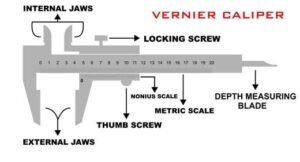
Vernier Calipers:
Measures small lengths accurately. Least count = 0.01 cm = 0.1 mm.
Least Count = Smallest division on main scale / Number of divisions on vernier scale
Screw Gauge:
Measures very small lengths like diameter of wire. Least count = 0.01 mm = 0.001 cm.
Least Count = Pitch / Number of divisions on circular scale

Physical Balance:
Used to measure mass of a body by comparing with known masses.
Stopwatch:
Measures time interval. Mechanical stopwatch L.C = 0.1 s. Digital stopwatch L.C = 0.01 s.
SIGNIFICANT FIGURES
In any measurement, the accurately known digits and the first doubtful digit are called significant figures.
Rules:
- All non-zero digits are significant.
- Zeros between non-zero digits are significant.
- Zeros to the left of first non-zero digit are not significant.
- Zeros to the right of decimal point are significant.
Example: 2305 has 4 significant figures, 0.0045 has 2 significant figures, 1.200 has 4 significant figures.
PRECISION AND ACCURACY
Precision: Refers to how close the measured values are to each other. Depends on the least count of instruments.
Accuracy: Refers to how close a measured value is to the true value.
A measurement can be precise but not accurate, and vice versa.
ERRORS
The difference between measured value and true value is called error.
Types: Random error, Systematic error, Personal error.
If you want to download book exercise questions and answers pdf of Sindh text Book for 9th Class.
DownloadPhysical Quantities Quizzes.
Finally dear reader. i am writing this blog to keep a clear, organized record of physical quantities, covering their definitions, units and practical uses. Additionally, don’t forget to check the mathematics quizzes on this site, they will help you practice and strengthen your grasp of mathematics.
Share this content:







Post Comment